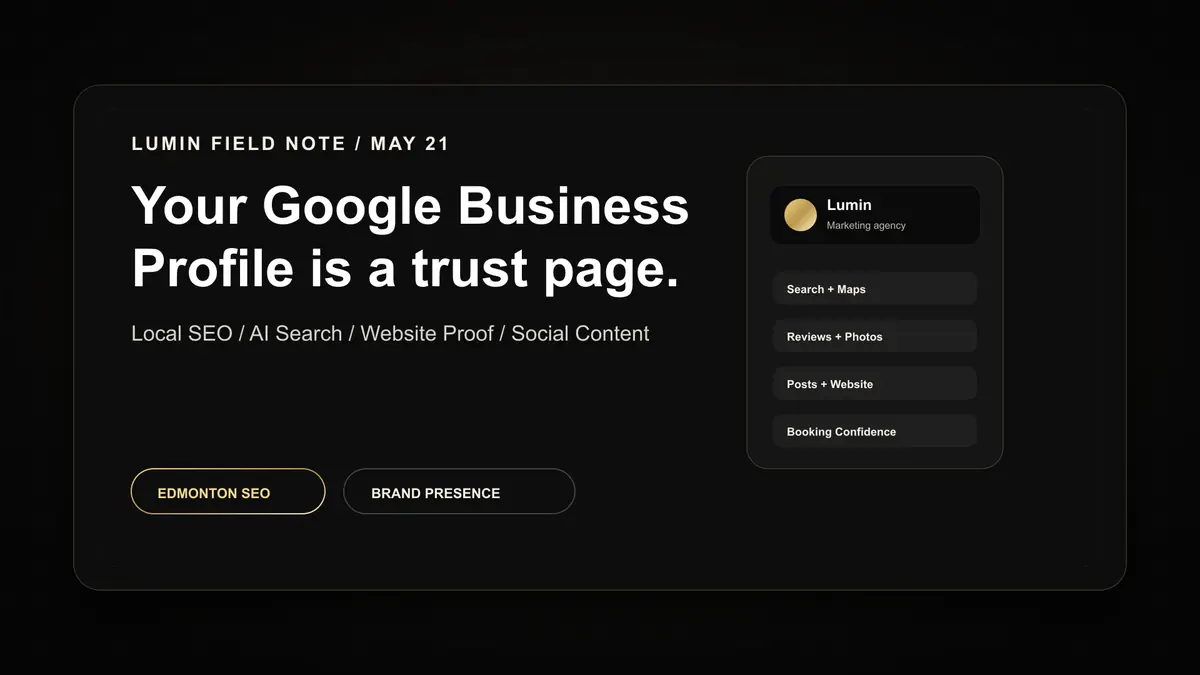
Your Google Business Profile is a trust page now.
The May 21 Lumin Signal builds on AI search and customer questions: your Google Business Profile is not just a listing. It is a public trust page that needs current proof, clear answers, and a connected website path.
The short version
Your Google Business Profile is a public trust page, not just a listing, and it matters more as AI Mode searches grow longer and more specific. Keep the name, phone, website, category, hours, photos, and description current and consistent, publish useful updates tied to customer questions, and link them back to your website.
On May 21, 2026, the local SEO question for Edmonton businesses is not only, "Are we on Google?" The better question is, "When someone finds us on Google, do they have enough reason to trust us?"
Yesterday's Lumin Signal focused on how customer questions are becoming the strategy for AI search. Today builds on that idea by asking where those answers should show up first.
One of the highest-impact places is your Google Business Profile.
For many local businesses, the profile is the first serious proof point a customer sees. It can show your website, phone number, reviews, business category, photos, videos, posts, service details, hours, location or service area, and the freshest signs that the business is active. Google says Business Profile posts can appear to customers on Search and Maps, and can include text, photos, videos, and action buttons. That makes the profile more than a directory listing. It is part of the decision path.
If your profile is outdated, thin, inconsistent, or disconnected from your website and social content, it quietly weakens trust. If it is current, clear, visual, and connected, it helps people move from search to confidence to booking.
Why the profile matters more in AI search
Google's AI search updates are changing how people ask questions. Google reported that AI Mode has passed one billion monthly users globally, and that the average AI Mode search is about three times longer than a traditional search query. Google also says people are using voice, images, planning searches, follow-up questions, and more specific decision-making language.
That matters for local SEO because customers are no longer only searching short phrases like "marketing company Edmonton" or "website designer near me." They may ask longer questions like:
- Who can help my Edmonton business look more professional online?
- What marketing support should I hire first if I need more bookings?
- Which local agency can create content, update my website, and help with Google visibility?
- How do I make my business look trustworthy before people contact me?
Those questions need more than a business name. They need proof.
Your Google Business Profile can support that proof, but only if it reflects the business you are today. A stale profile with old photos, old phone numbers, vague categories, inconsistent links, and no recent updates makes the business feel harder to trust. A current profile gives Google, searchers, and potential clients clearer signals about what you do, where you serve, and why you are worth considering.
A Google Business Profile is part of your content system
A common mistake is treating Google Business Profile as an admin task: update the hours, add the phone number, move on.
That is too small.
For a local business, the profile should be part of the same content system as the website, blog, short-form video, Instagram, LinkedIn, Facebook, YouTube, and sales follow-up. Each piece should answer the same buyer questions in a slightly different format.
If your website publishes a post about how one filming day can support a full content system, your Google Business Profile can share the practical takeaway with a photo and a link. If your blog explains how AI search is changing customer behaviour, your profile can share a short update that points people to the article. If your service page explains content creation in Edmonton, your profile photos should show real content work, real team context, and current brand visuals.
That is how the pieces start compounding.
The website gives depth. Google Business Profile gives local discovery and quick trust. Social content gives visibility and proof. Short videos give energy. Blog posts give answers. Service pages give structure. Together, they create a clearer path to booking.
What customers look for before they click
When someone opens a local profile, they are usually trying to reduce risk.
They want to know:
- Is this business active right now?
- Is the phone number and website current?
- Do the photos match the service being sold?
- Do the reviews feel real and recent?
- Does the business serve my area?
- Can I understand what they do quickly?
- Is there a next step that feels easy?
This is why inconsistent information creates friction. If the website says one number, a social post says another number, and the Google profile keeps showing old information, the customer has to work harder to trust the business. Google may also see conflicting public information and become more cautious with profile edits.
For Lumin, this is not theoretical. We have been cleaning up old phone numbers, old links, outdated service language, and mismatched social bios because local SEO depends on consistency. The public offer now needs to point clearly to content creation, cinematic websites, local SEO, and brand presence. The public footprint has to catch up everywhere.
That is the real work of modern local SEO. It is not only keywords. It is accuracy, clarity, freshness, and proof.
What to update first on your Google Business Profile
If your profile has not been reviewed recently, start with the details that create or destroy confidence fastest.
First, confirm the basics. Business name, primary phone number, website URL, category, business hours, service area, address settings, and appointment links should match the website and social profiles. Do not use temporary bio links, old campaign landing pages, or outdated phone numbers as the main business contact path.
Second, update the photos. A profile image should reflect what the business is now, not an old offer, old campaign, or generic stock-style scene. Photos should support the buying decision. For a content and website company, that may mean team visuals, branded content, work examples, behind-the-scenes shots, podcast or studio visuals, and clean graphics that match the site.
Third, review the business description and services. The language should make the current offer obvious. For Lumin, that means terms like Edmonton content creation, cinematic websites, local SEO, social media content, brand presence, website design, and marketing strategy. It should not lead with retired service language if that is no longer the core direction.
Fourth, publish a current update. Google allows businesses to share updates, offers, events, photos, videos, and action buttons through Business Profile posts. A good update should not be stuffed with keywords. It should give one useful idea, connect to a current service or article, and make the next step easy.
Fifth, connect the profile back to the website. Your Google update should not leave someone stranded. Link to the relevant blog post, service page, pricing page, or booking section.
What not to do
Do not treat Google Business Profile posts like random social captions. A profile post is usually seen by someone already closer to a decision. They searched for the business, the service, or the category. That means the post should help them decide.
Avoid vague updates like:
"We help businesses grow. Contact us today."
A stronger update says:
"If your Edmonton business is posting on social media but still not getting more inquiries, check whether your website, Google Business Profile, and service pages answer the questions customers ask before booking. We wrote a practical guide on turning customer questions into content that supports AI search, local SEO, and trust."
That is more useful. It names the problem, the audience, the service context, and the next step.
Also avoid putting phone numbers directly into every post description. Google notes that posts with phone numbers in the description might be rejected. Use the official phone field on the profile and keep posts focused on useful context, links, photos, videos, and action buttons.
How this connects to website SEO
Google Search Central says the same foundational SEO best practices still matter for AI features like AI Overviews and AI Mode. Pages need to be crawlable, eligible to appear in search, technically sound, and built around helpful, reliable, people-first content. There are no magic extra steps just for AI search.
That is important because a Google Business Profile does not replace the website. It supports it.
Your website is still where you control the deeper explanation. The profile can bring someone to the door, but the website needs to help them walk through it. That means the homepage should explain the offer. Service pages should answer buying questions. Blog posts should support topic clusters. Images should have useful alt text. Internal links should guide people to the next page. The booking path should be obvious on mobile.
For Lumin, a strong path might look like this:
- A Google Business Profile update introduces a practical local SEO idea.
- The update links to a blog post like this one.
- The blog post links to SEO content strategy, brand presence, and cinematic websites.
- The service page explains who the service is for and what is included.
- The visitor can book from the page without hunting.
That path is better for people and easier for search systems to understand.
A practical May 21 checklist
If you want to apply this today, do this in order.
1. Search your business name in Google and open the public profile. 2. Check the phone number, website, category, hours, and service area. 3. Remove or replace any outdated links, old campaign language, or mismatched offers. 4. Add one current image that reflects what the business sells now. 5. Write one Google Business Profile update connected to a real customer question. 6. Link that update to a relevant blog post or service page. 7. Make sure the same topic appears on your website and at least one social channel. 8. Review the full path on mobile. 9. Save the question in a content bank so it can become a future short video, FAQ, or article. 10. Repeat weekly with one useful update instead of ten random posts.
This is not about chasing the algorithm. It is about making the business easier to understand everywhere people look.
The Lumin recommendation
For Edmonton businesses, Google Business Profile optimization should not live alone. It should be connected to website structure, content creation, social media content, local SEO, and brand presence.
If your profile is accurate but your website is thin, the trust path breaks. If your website is strong but your profile is outdated, the trust path breaks. If your social content shows an old offer, the trust path breaks. If your photos do not match the business, the trust path breaks.
The businesses that win are the ones that make the public footprint feel current and consistent.
That is why Lumin is building content, cinematic websites, service pages, blog posts, Google updates, and short-form videos as one connected visibility system. The goal is simple: help the right customers find the business, understand the offer, trust the proof, and know what to do next.
If your business needs help cleaning up Google visibility, turning customer questions into SEO content, or building a website and content system that supports bookings, book a strategy call with Lumin.