Generic content is getting easier to ignore.
Google says generative AI search still depends on strong SEO foundations. The opportunity for local businesses is not more generic posts. It is content only your business could publish.
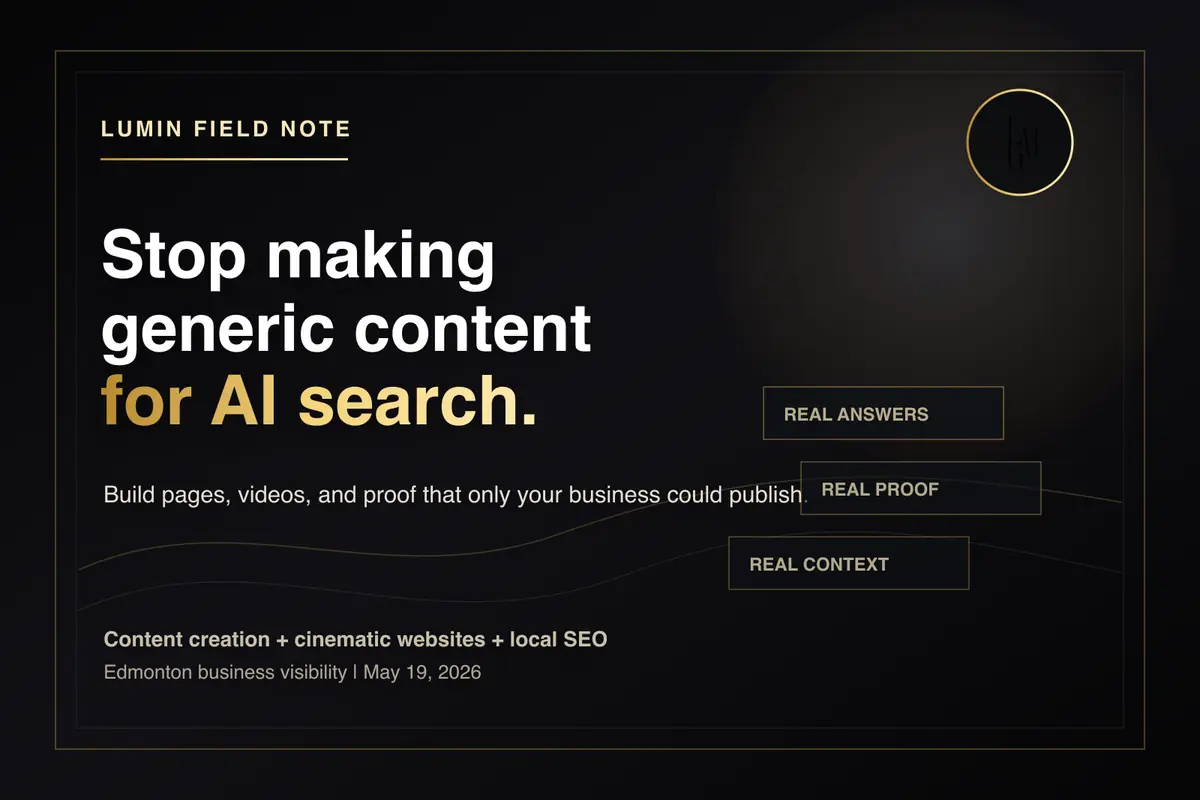
The short version
Publish content only your business could write. Google says its AI search features still run on core ranking systems, so the edge is non-commodity content: real local context, your actual process, specific examples, and original visuals. Start from the offer and the questions customers ask before booking, then turn each proof point into website, video, and blog assets.
There is a new SEO lesson for May 19, 2026, and it is surprisingly practical: AI search is not asking local businesses to become more robotic. It is asking them to become more specific.
Google's Search Central guidance, last updated May 15, 2026, makes the point clearly. Generative AI features in Google Search, including AI Overviews and AI Mode, still rely on Google's core Search ranking and quality systems. Google also describes query fan-out, where AI search may run several related searches around one question to build a stronger answer.
For Edmonton businesses, that means the goal is not to chase a new acronym every week. It is to create content that can survive comparison. The businesses that win are the ones with useful service pages, clear offers, original visuals, current business details, and answers that feel like they came from real experience.
Generic content is becoming easier to produce, so it is also becoming easier to ignore.
What non-commodity content means
Google's newer AI optimization guidance uses a phrase that matters: non-commodity content. In plain language, that means content that is not just a recycled version of what every other business could say.
A commodity post says, "Five reasons your business needs marketing." A non-commodity post explains the actual buying questions customers ask before booking, the mistakes the business sees in the local market, the process behind the work, the tradeoffs between package options, or the reason a certain creative decision matters.
The difference is proof.
If a post could be published by any business in any city, it will probably feel forgettable. If it includes local context, real process, specific examples, original images, and a clear point of view, it becomes more useful for people and easier for search systems to understand.
That is why Lumin does not treat blog posts, reels, website pages, Google Business Profile updates, and LinkedIn posts as separate chores. They should all come from the same source of truth: what the business actually does, what customers need to know, and what proof makes the offer believable.
Why this matters for local SEO
Local SEO used to feel mostly technical: add keywords, update a Google Business Profile, collect reviews, and build pages. Those pieces still matter. But AI search and social search are making context more important.
A customer searching for a marketing company in Edmonton may not type one simple keyword anymore. They might ask a longer question like, "Who can help my local business look more professional online and create content for Instagram and Google?" They might compare agencies, open Maps, check social profiles, watch a short video, and scan a blog before they book.
AI search is built for those more complex questions. That means a thin service page is not enough. Your website needs enough useful text, visuals, internal links, structured information, and local clarity for both people and search systems to understand what you do.
A strong page should answer:
- Who is this service for?
- What problem does it solve?
- What is included?
- What does the process look like?
- What does the customer need before starting?
- What proof can they see?
- What should they do next?
That is not keyword stuffing. That is useful communication.
The content mistake many businesses are making
The biggest mistake right now is using AI to create more average content instead of using it to organize better thinking.
AI can help outline, draft, repurpose, and speed up production. But if the input is vague, the result will sound like everyone else. A business owner who asks for "a social media post about marketing" will usually get a polished paragraph with no real signal.
The better input is specific:
- What did a customer ask this week?
- What objection keeps delaying bookings?
- What part of the service do people misunderstand?
- What local comparison are customers making?
- What proof do we have that should be easier to see?
- What would someone need to believe before contacting us?
Those questions turn content into strategy.
For example, a restaurant does not need another generic post about supporting local. It may need a short video showing atmosphere on a Friday night, a page that explains private event bookings, Google photos that match the current room, and a blog post about choosing a venue for a small Edmonton celebration.
A contractor may not need another "quality workmanship" caption. They may need project photos, a service page that explains quote expectations, a short video on what happens during the first site visit, and a post that answers how long a typical project takes.
A professional service brand may not need another graphic about trust. It may need founder-led content, clear pricing context, a stronger About page, and proof that the team understands the customer's real risk.
How to build a better content system
Start with the offer. Before posting more, write down the exact service you want people to book. If the offer is unclear, the content will drift.
Then list the questions customers ask before they say yes. These are often better blog topics than trend-based headlines because they connect directly to buying intent.
Next, capture proof. Proof can be a finished project, a behind-the-scenes clip, a before-and-after, a founder explanation, a process photo, a sample deliverable, or a clear answer to a common objection. For many local businesses, one content day can create enough raw material for reels, website sections, Google updates, blog visuals, and sales follow-up.
Then turn each proof point into multiple assets:
- A website section that explains the offer
- A short-form video that shows the proof quickly
- A blog post that answers the deeper question
- A Google Business Profile update for local discovery
- A LinkedIn or Facebook post that gives the human context
- An internal link from the article to the relevant service page
This is where content creation, cinematic website design, social media content, and SEO content strategy should work together. One idea should not die after one post.
What to publish on May 19
If your business wants one practical move this week, publish a post that only your business could write.
Do not start with "Here are five tips." Start with a real customer problem. Explain what people usually misunderstand. Show what your process looks like. Add a real image or video. Link to the related service. Make the next step obvious.
For Lumin, that means building a connected brand presence instead of random content. The website should explain the offer. The blog should answer real questions. The Google Business Profile should stay accurate and active. The social channels should show the people, process, and proof behind the work. The booking path should be clear on mobile.
That is how visibility becomes trust.
The Lumin recommendation
The businesses that stand out in AI search will not be the ones publishing the most generic content. They will be the ones publishing the clearest evidence.
For Edmonton businesses, the advantage is still wide open. Many local competitors have outdated websites, thin service pages, inconsistent social profiles, weak images, and content that does not answer buying questions. A business that fixes those pieces can become easier to find, easier to understand, and easier to choose.
Lumin helps local businesses build that kind of presence through content creation, cinematic websites, social media content, SEO content strategy, and brand visibility systems.
If your business needs a clearer content plan for AI search, local SEO, and social visibility, book a strategy call with Lumin.