One filming day should feed your whole brand presence.
A filming day should not disappear after one reel. It should become a reusable content system for your website, social media, Google profile, and booking path.
The short version
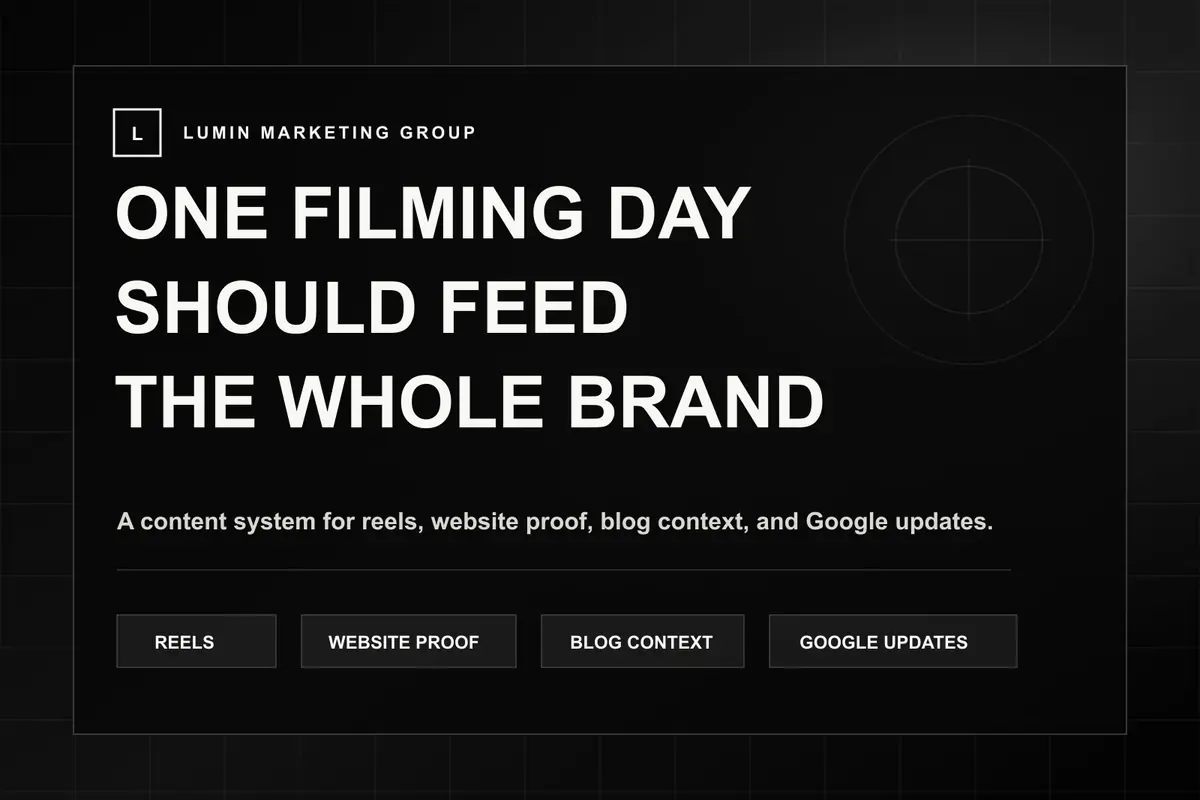
One filming day should feed your whole brand presence, not disappear after a single reel. Plan the shoot around what you need to prove, then reuse the footage as homepage visuals, service-page proof, Google Business Profile photos, blog images, faq clips, and ads. Build attention, trust, website proof, and booking support so content becomes a system, not a weekly scramble.
A lot of businesses treat content like a single post. Film a reel, write a caption, publish it, and then start from zero again next week.
That is exhausting. It is also a missed opportunity.
The stronger approach is to turn one good filming day into a content system that supports your website, social media, Google Business Profile, blog, service pages, and booking path. That matters because customers rarely decide from one post alone. They notice the business somewhere, check the website, compare the offer, look for proof, and then decide whether it feels worth reaching out.
For Edmonton businesses, this is one of the most practical marketing moves right now: stop creating disconnected posts and start building reusable proof.
The trend: one asset needs to work harder
The current content trend is not simply to post more. It is to make every useful piece of content travel farther across the places customers already check.
Short-form video can still create attention, but the same shoot can also give you homepage visuals, service-page proof, Google Business Profile photos, blog images, FAQ clips, social captions, email content, and ad creative. Instead of asking, "What should we post today?" the better question is, "How can this proof support the whole customer journey?"
That shift matters for small and mid-sized businesses because content takes time, energy, coordination, and money. A filming day should not disappear after one reel. It should become a small library of assets that make the business easier to understand, easier to trust, and easier to book.
This is where content creation, social media content, cinematic website direction, and SEO content strategy should connect.
What one filming day can become
A strong content day starts before the camera comes out. The business needs to know what it is trying to prove.
For a restaurant, the proof might be atmosphere, food quality, service, and why someone should choose it for a night out. For a wellness studio, the proof might be calm, professionalism, process, and the feeling of the space. For a trades company, the proof might be workmanship, reliability, equipment, job site care, and a clear quote process. For a professional service brand, the proof might be expertise, trust, team personality, and how the first conversation works.
Once the proof is clear, one filming day can create:
- Short-form reels for Instagram, TikTok, YouTube Shorts, and Facebook
- Website hero clips or stills that make the homepage feel current
- Service-page visuals that show the work instead of only describing it
- Google Business Profile photos and updates that show the business is active
- Blog images that make articles feel original instead of generic
- FAQ clips that answer customer objections before a sales call
- Ad creative for future campaigns
- Behind-the-scenes content that makes the brand feel human
That is not more content for the sake of more content. It is one creative session planned around multiple jobs.
Why this helps SEO without chasing tricks
Google's guidance keeps coming back to helpful, reliable, people-first content. For a local business, original visual proof supports that idea because it gives people more context about who you are, what you do, and why the work is credible.
Search engines can read text, but customers read the whole experience. A service page with original photos, clear headings, useful explanations, internal links, and a simple booking step feels more trustworthy than a page with broad claims and no proof.
That is why content should not live only on social media. Social platforms are useful for discovery, but the website is where the business can organize the proof into a decision path.
A reel can make someone curious. A service page can explain the offer. A blog post can answer the next question. A pricing page can frame the scope. A booking form can turn interest into a conversation. When those pieces connect, content becomes part of the conversion system.
The simple content system Lumin recommends
If you want a practical rhythm, build from four layers.
First, create attention content. These are short clips, photos, and posts that make people stop for a second. They should show the business clearly: the space, the people, the work, the process, the result, or the problem being solved.
Second, create trust content. These pieces answer the quiet questions people ask before they reach out. What is included? Who is this for? What does the process feel like? What makes the business different? What should someone expect after booking?
Third, create website proof. Put the strongest visuals and explanations on the pages where people make decisions: homepage, service pages, pricing, portfolio, and blog posts. Social content disappears quickly. Website proof keeps working.
Fourth, create booking support. Every content path should make the next step easy. If someone reads the article, watches the reel, or lands on a service page, they should know what to do next without hunting.
That is how content becomes a system instead of a weekly scramble.
A practical checklist before your next shoot
Before the next filming day, answer these questions:
- What service or offer needs more trust right now?
- What customer question should this content answer?
- What proof would make someone feel more confident booking?
- Which website pages need original visuals?
- Which clips can become reels, ads, FAQs, and Google Business Profile updates?
- What internal links should the blog post or service page include?
- What call to action should every asset support?
- How will the content be named, organized, and reused after delivery?
The last question matters more than people think. If files are scattered, unnamed, or created without a plan, the content gets used once and forgotten. A proper content library lets the business keep showing up without rebuilding from zero every week.
The mistake: making content that has nowhere to send people
A reel can perform well and still fail the business if there is no strong place to send the attention.
If the website is unclear, the service pages are thin, the pricing context is missing, or the booking form feels buried, the content has to do too much work alone. That is when businesses feel like they are posting constantly but not seeing enough inquiries.
The problem is not always the content. Sometimes the problem is the path after the content.
That is why Lumin builds content around the full brand presence: message, visuals, website structure, SEO content, service pages, and booking flow. The goal is not just to make something look good in the feed. The goal is to make the business easier to choose.
What this means for Edmonton businesses
If your business is investing in content creation, make sure the work supports more than one platform.
Your filming day should help your website feel current. Your website should help your social content convert. Your blog should support your service pages. Your Google Business Profile should show recent proof. Your booking path should be easy to find from every high-intent touchpoint.
This is especially important for local Edmonton businesses because people compare quickly. They may find you through search, see you on social, check your reviews, open your website, and decide within minutes whether you feel credible.
Every piece of content should help answer that decision.
Build a presence, not a pile of posts
The businesses that win attention for a week are loud. The businesses that earn trust over time are organized.
One good filming day can become the start of that organization if it is planned properly. It can feed social media, strengthen the website, support local SEO, update the Google Business Profile, and give future customers more reasons to trust the brand before they reach out.
If your business needs content that works beyond the feed, book a strategy call with Lumin. We will help you decide what to film, where it should live, and how to turn it into a brand presence that supports real bookings.