Your customers are searching everywhere now.
Google still matters, but customers are also searching Instagram, TikTok, YouTube, Maps, reviews, and AI answers. The businesses that win will connect content, website structure, and trust into one clear presence.
The short version
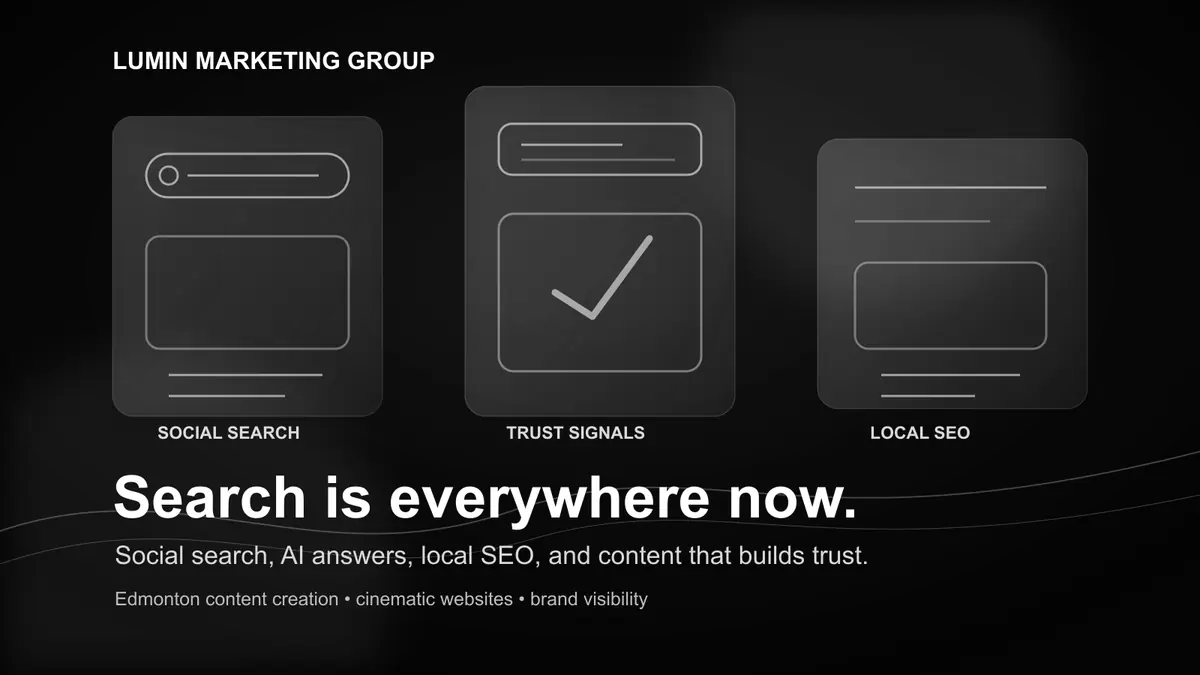
Customers no longer search in one place. They check Google, Instagram, TikTok, YouTube, Maps, reviews, and AI answers before deciding who to contact. Make social content searchable using the real phrases people ask, then connect it to a clear website with strong service pages and an easy booking path. Discovery happens on social; the decision happens on your site.
People are not searching in one place anymore. They are checking Google, Instagram, TikTok, YouTube, Maps, Reddit, reviews, AI answers, and the business website before they decide who feels worth contacting.
That is the marketing shift Edmonton businesses need to understand right now.
Search used to feel like a straight line. A customer typed a phrase into Google, clicked a website, and made a decision. Now discovery is scattered across platforms. Someone might see a reel first, search the business name on Instagram, check Google reviews, scan the website, ask an AI tool for recommendations, and then come back later through Maps.
For a local business, that means visibility is no longer just about ranking one page. It is about building a brand presence that can be understood anywhere someone finds you.
The trend: social search is becoming buying research
Social platforms are not only entertainment feeds anymore. People use them like search engines. They search for tutorials, reviews, local recommendations, examples, prices, services, and proof that a business is real.
A potential customer looking for a marketing company in Edmonton might not start with the phrase "marketing agency Edmonton" on Google. They might search Instagram for content creators in Edmonton. They might look for local business website examples. They might check TikTok for advice about small business marketing. They might watch YouTube Shorts about branding, SEO, or social media strategy. They might ask an AI tool what kind of marketing support a local service business should hire first.
The point is not that Google is gone. Google still matters. The point is that Google is no longer the only place where trust starts.
That is why businesses need content that is searchable, visual, useful, and connected back to a strong website.
What this means for Edmonton businesses
If your business only has a website, you may be missing the places where people first discover you. If your business only posts on social media, you may be missing the place where people need deeper proof before they book.
The stronger play is to connect both.
Your social media should make the business easier to find and remember. Your website should make the business easier to understand and trust. Your blog should answer the questions people ask before they buy. Your service pages should explain what you do clearly enough for people and search systems to connect the dots.
For Lumin, that is the whole point of brand presence. Content creation, social media content, cinematic websites, SEO content strategy, and brand presence should not live in separate boxes. They should support the same decision path.
The new visibility question
A few years ago, a business owner might ask, "Are we ranking on Google?"
That question still matters, but it is too narrow now.
A better question is: "When someone searches for what we do anywhere online, do we look clear, current, credible, and easy to contact?"
That question changes the work.
It means your Instagram bio needs searchable language. Your reels need captions and on-screen text that match how customers actually ask questions. Your Google Business Profile needs accurate details and recent proof. Your website needs service pages with clear headings, local context, internal links, and a booking path. Your images need descriptive alt text. Your blog posts need to answer real search intent instead of just filling space.
Search is becoming less about one ranking and more about total confidence across the brand.
What people are really looking for
When someone searches for a business, they are usually trying to reduce risk.
They want to know:
- Does this business understand my problem?
- Do they serve my area?
- Can I see proof of the quality?
- Do they feel active and current?
- Is the offer clear?
- What does it cost or what affects the scope?
- What happens after I reach out?
- Do I trust the people behind it?
This is why generic content does not work very hard anymore. A vague post that says "we help brands grow" does not answer much. A stronger post shows the work, explains the decision, names the service, gives local context, and points people toward the next step.
The same is true on a website. A homepage can look beautiful and still fail if visitors cannot quickly understand what the business does, who it serves, why it is credible, and how to book.
How to make social content searchable
Social search content needs to be designed around real phrases people use.
For an Edmonton business, that could mean captions and overlays like:
- "How to make your Edmonton business look more professional online"
- "Content ideas for local restaurants in Edmonton"
- "What to film before launching a new website"
- "Why your service page is not turning visitors into leads"
- "How to use one filming day for reels, website visuals, and Google updates"
Those phrases are not random hashtags. They are customer questions. They help the platform understand the content, and they help a person recognize that the video is relevant.
A good short-form video should usually include four things: a clear hook, visual proof, plain-language explanation, and a next step. That next step does not always need to be a hard sell. Sometimes it is a related blog post, a service page, a portfolio example, or a booking link.
The key is that the content should not leave people impressed but stranded.
Why the website still matters
Social search can create discovery, but the website still carries the decision.
A person can like a reel and still need a serious place to check the offer. They need to see the service, the process, the pricing context, the proof, the team, the story, and the booking path. That is hard to do inside one post.
This is where a cinematic website becomes more than a design choice. It gives the business a controlled place to explain the brand clearly. It can organize content into sections people actually need: services, pricing, work examples, blogs, FAQs, legal pages, and booking.
It also gives search engines and AI systems a clearer source to understand what the business offers.
If your social content is the spark, your website is the structure.
AI search raises the bar for clarity
AI search does not remove the need for SEO. It makes clarity more important.
Google's own guidance for AI features continues to point back to the same foundations: technically accessible pages, helpful content, clear structure, people-first information, and content that search systems can crawl and understand.
That means businesses should avoid chasing shortcuts. The better approach is to build pages that answer real questions completely enough to be useful.
For Lumin, this means every serious service page should explain who the service is for, what is included, how the process works, what proof supports it, what related services connect to it, and what the next step should be. Every blog post should support a real topic cluster. Every image should have context. Every internal link should help the visitor move.
AI search rewards sources it can understand. People do too.
A practical visibility system for this month
If you want to improve how your business shows up across search, start with a simple system.
First, clean up your core brand details. Make sure your business name, phone number, website, service area, and social links are consistent everywhere they appear.
Second, update your website's high-intent pages. Your homepage, service pages, pricing page, our story page, and booking flow should feel current and easy to understand.
Third, create one helpful blog post that answers a real buying question. Link it to a related service page so readers can keep moving.
Fourth, turn that blog idea into three to five short-form videos. Use plain search phrases in the hook, caption, and on-screen text.
Fifth, update your Google Business Profile with fresh photos, a post, and accurate information.
Sixth, review the whole path on mobile. Many people will discover you through a phone, and a glitchy mobile experience quietly kills trust.
This is not about doing everything at once. It is about making every piece support the same presence.
What Lumin recommends before your next content day
Before you film or redesign anything, decide what needs to become easier to believe.
Do people need to understand your offer? See your work? Trust your process? Meet the people behind the business? Compare packages? Know what happens after they book?
That answer should guide the content.
A strong content day can create search-friendly reels, website visuals, blog images, service-page proof, Google Business Profile updates, and sales material. A strong website can turn those assets into a decision path. A strong SEO strategy can connect the pages so search engines and people understand what the business should be known for.
That is how content becomes more than posting. It becomes a visibility system.
The takeaway
The businesses that win in 2026 will not be the ones posting randomly on every platform. They will be the ones building a connected presence that helps people find them, understand them, trust them, and contact them.
Social search is rising. AI search is changing discovery. Google still matters. Local proof still matters. Websites still matter. The real advantage is connecting all of it into one clear brand presence.
If your business needs help turning content, website structure, and SEO into a stronger path to bookings, book a strategy call with Lumin. We will help you decide what to create first, where it should live, and how to make your brand easier to find everywhere customers are searching.