Search is rewarding businesses that look real.
AI search, social search, and Google Business Profile visibility all point to the same lesson: customers choose businesses they can understand, verify, and trust.
The short version
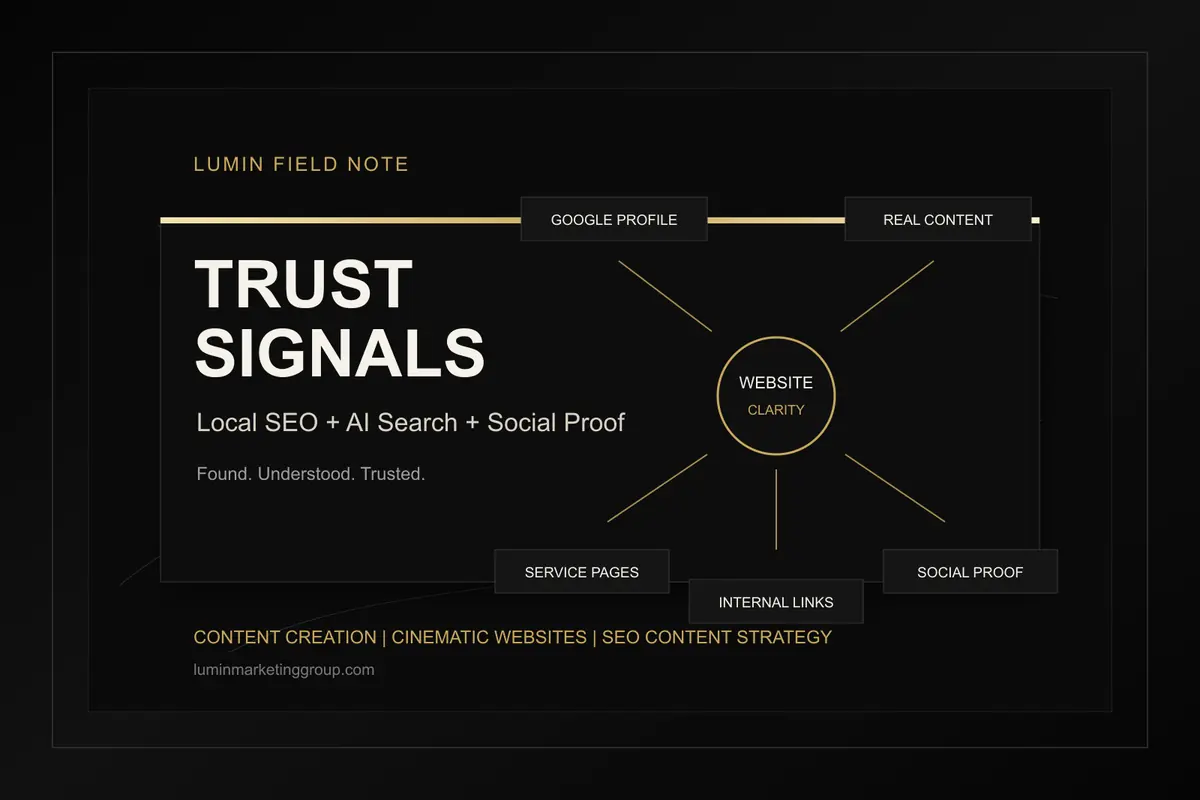
Search now rewards businesses that look real, current, and consistent everywhere a customer checks. Before posting more, align your name, phone, and offer across Google, your website, and social profiles, strengthen thin service pages, and add real proof like fresh photos and founder-led content. Trust signals, not generic posts, turn search visibility into bookings.
Search is changing again, but the businesses that win are not the ones chasing every new acronym. They are the ones that look real, current, specific, and easy to trust everywhere a customer checks.
That matters for Edmonton businesses right now because customers are not using one path anymore. They might see your reel, search your business name, open your Google Business Profile, scan your reviews, look at your website, check your LinkedIn or Facebook, ask Google or an AI tool for recommendations, and then decide whether you feel worth contacting.
The trend is clear: visibility is becoming proof-driven. Search systems need clear signals. People need confidence. The strongest local brands give both.
The trend: search wants clearer proof
Google's newer AI search experiences, including AI Overviews and AI Mode, are built to help people explore topics, compare options, and find supporting websites. Google's own guidance still points back to the same practical SEO foundations: crawlable pages, helpful content, internal links, strong page experience, useful images or videos, accurate structured data, and an up-to-date Business Profile.
That is useful for business owners because it cuts through the noise. You do not need to rebuild your whole marketing around buzzwords like GEO or AEO. You need a website, content system, and social presence that make the business easier to understand.
At the same time, Google has also been adding more ways for people to explore original content, public discussions, social posts, and firsthand perspectives. That means a business's visibility is no longer only about what is written on the homepage. It is about the complete public footprint.
For a local business, the real question becomes this:
When someone checks you across Google, your website, social media, and search results, does the business feel consistent, active, and credible?
Why trust signals matter more than generic content
A trust signal is anything that helps a person believe the business is real, capable, and relevant to their need.
That can be a clear service page. It can be a recent Google Business Profile photo. It can be a founder-led post. It can be a short-form video that shows the work. It can be a pricing explanation. It can be an Our Story page. It can be a blog post that answers a real buying question instead of repeating vague marketing advice.
The mistake many businesses make is publishing content that technically exists but does not reduce doubt. A post that says, "We help businesses grow" does not prove much. A page that says, "We offer social media marketing" does not tell a customer what happens next. A stock image does not show the real business. A thin service page does not explain why someone should trust the offer.
Search may bring people to the door, but trust is what makes them take the next step.
What customers check before they book
Most customers do not think of this as a marketing journey. They just check what feels natural.
They want to know what you do. They want to know if you serve their area. They want to see whether the business is active. They want to understand the offer. They want to see some kind of proof. They want the phone number, website, and social profiles to match. They want to know what happens after they reach out.
For Edmonton businesses, this matters because local buyers compare quickly. They may open three marketing companies, three salons, three contractors, or three restaurants in the same sitting. The business that feels clearer and more current often gets the advantage before the sales conversation even begins.
That is why your online presence should answer these questions without making people work:
- What service do you provide?
- Who is it for?
- What city or service area do you serve?
- What does the process look like?
- What proof can someone see?
- What makes the business different?
- What should someone do next?
If those answers are scattered, outdated, or missing, customers hesitate.
The local SEO signals that still matter
Local SEO is not dead. It is just more connected than it used to be.
Your Google Business Profile still matters. Your website still matters. Reviews still matter. Service pages still matter. Internal links still matter. Metadata, image alt text, structured data, and mobile experience still matter. The difference is that these pieces need to support the same story.
A strong local SEO setup should include:
- A homepage that clearly says what the business does and where it serves
- Individual service pages for high-intent searches
- A Google Business Profile with accurate contact information and fresh photos
- Blog posts that answer real customer questions
- Original images with descriptive alt text
- Internal links between related services and articles
- A pricing or package page that explains scope
- Social profiles that use the same offer language
- A booking path that is easy to find on mobile
None of this is flashy. That is the point. It is the foundation that lets people and search systems understand the business.
Why social content now supports search
Social platforms are not only places to post updates. People use them to research businesses. They search TikTok, Instagram, YouTube, Facebook, LinkedIn, and X for examples, reviews, advice, and signs that a brand is alive.
That does not mean every business needs to be everywhere all the time. It means your active social profiles should help people confirm the same message they saw on your website.
If your website says you create cinematic content, your social feed should show visual proof. If your service page says you help with local SEO, your posts should explain practical SEO decisions. If your brand is built around trust, the people behind the company should be visible enough to make the business feel human.
This is also where founder-led content becomes powerful. In 2026, people are skeptical of faceless brands and generic AI-sounding posts. A founder, team member, or creator explaining what they are seeing in the market can build more trust than a polished graphic with no point of view.
For Lumin, this is why Kristina's personal Facebook presence, Lumin's LinkedIn, the website blog, Google Business Profile updates, and short-form content should all work together. The full article belongs on the website. The practical takeaway belongs on Google Business Profile. The professional angle belongs on LinkedIn. The human angle belongs on Kristina's Facebook.
Same idea, different context.
What to fix before posting more
Before a business increases posting frequency, it should make sure the core trust signals are not fighting each other.
Start with consistency. The business name, phone number, website, categories, descriptions, and services should match across Google, the website, LinkedIn, Facebook, Instagram, TikTok, X, and any directory profiles. Conflicting details can create confusion for customers and search systems.
Then check the homepage. A visitor should know what you do within a few seconds. If the hero looks nice but does not explain the offer, the page is losing people.
Then check the service pages. Each important service should have enough detail to stand on its own. A content creation page should explain what is included. A cinematic website page should explain how the website supports trust and booking. An SEO content strategy page should explain how blogs, internal links, metadata, and service pages work together.
Then check your images. Original photos and graphics should have descriptive alt text. Blog images should match the brand. Google Business Profile photos should reflect what the business is now, not an old offer.
Then check the CTA. If someone is ready to ask a question, the next step should be obvious.
A simple trust signal checklist for this week
If you want to improve local visibility this week, do not start with a giant rebrand. Start with one useful pass across the assets customers already see.
Update your Google Business Profile with the correct phone number, service categories, website link, and a fresh photo. Publish one Google post that points to a helpful blog article.
Update your website footer and contact details so they match every other platform. Make sure the phone number is crawlable text, not hidden inside an image.
Publish one blog post that answers a current customer question. Link it to at least one related service page and your booking section.
Turn that blog post into a LinkedIn post, Facebook post, Google Business Profile update, X post, and short-form video prompt. Do not copy and paste blindly. Adapt the hook for each platform.
Add one real proof asset: a team photo, behind-the-scenes clip, service explanation, process breakdown, or example of what a client receives.
Review the full journey on mobile. Most people will judge you from a phone.
What Lumin recommends
The businesses that grow from search in 2026 will not rely on one channel. They will build a connected presence.
That means the website explains the offer. The blog answers the questions. The service pages support search intent. The visuals prove the quality. The Google Business Profile confirms the details. The social posts make the business feel human. The booking path makes action simple.
This is the work that turns attention into confidence.
For Edmonton businesses, the opportunity is real. Many local competitors still have thin service pages, outdated photos, inconsistent profiles, and social feeds that do not connect back to a clear offer. A business that fixes those trust signals can become easier to find, easier to understand, and easier to choose.
If your business needs help building that kind of presence, Lumin can help with content creation, cinematic websites, social media content, SEO content strategy, and brand presence.
Start with the signal. Make the business clear. Show the proof. Then make the next step easy.
If you want a practical plan for your own business, book a strategy call with Lumin.